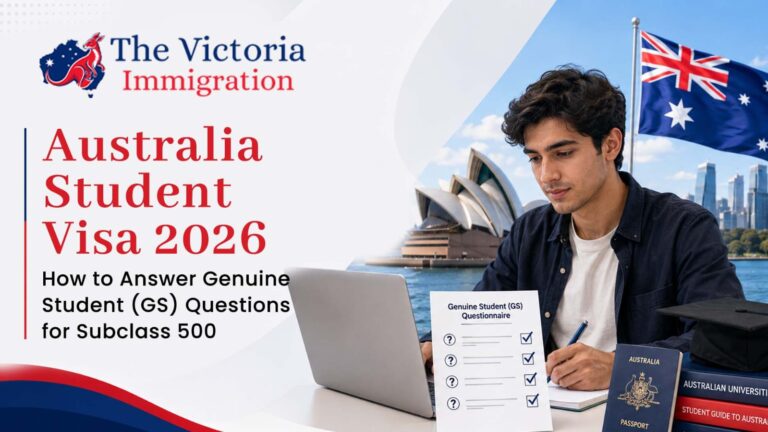
Applying for an Australian Student Visa in 2026 is no longer just about paperwork and a course offer. The Department of Home Affairs now weighs your answers to the Genuine Student (GS) questions almost as heavily as your financial documents. Get these responses right, and you move one step closer to studying in Australia. Get them wrong, and even a strong academic profile won’t save your application.
The GS requirement replaced the old Genuine Temporary Entrant (GTE) criterion back in March 2024, and it now shapes every Subclass 500 application. If you’re planning to study in Australia this year, understanding how case officers read your answers matters just as much as choosing the right course. This guide breaks down the Genuine Student requirement, walks through the core GS questions, and shows you exactly how to build answers that hold up under scrutiny.
Whether you’re a first-time applicant, a parent helping a child prepare, or an agent guiding students through the process, this guide gives you a practical, no-fluff roadmap. And if you’d rather have an expert review your responses before you submit them, The Victoria Immigrations offers hands-on support for exactly this stage of the application.
The Genuine Student requirement checks one simple thing: is studying in Australia genuinely your main reason for applying, and does your course choice make sense given your background and goals? It replaced the GTE test, which asked for a long personal statement. The GS framework instead uses short, targeted questions built directly into the online application form.
Australia introduced this change to streamline processing while still filtering out applications that treat the student visa as a backdoor into the country rather than a genuine study pathway. Every Subclass 500 applicant must satisfy this requirement, regardless of nationality, course level, or education provider.
GTE asked applicants to write a broad narrative. GS asks four focused questions, each capped at roughly 150 words. That shift means every sentence has to earn its place, and vague or generic answers stand out immediately to a case officer.
The Subclass 500 visa lets international students study full-time at a registered Australian institution, typically for the length of their course. Along with your study rights, the visa opens up a few practical benefits:
These benefits are worth protecting, which is exactly why the GS assessment carries so much weight in 2026.
Case officers now cross-check your GS answers against your academic transcripts, financial documents, and English test scores. If your statement says you’re pursuing a data analytics diploma to advance a marketing career, but your transcripts show no connection to either field, that inconsistency raises a flag. Officers aren’t looking for perfect prose; they’re looking for a story that adds up.
The most common refusal triggers this year include generic, copy-paste answers, academic regression without explanation, weak financial evidence, and responses that contradict supporting documents. Avoiding these pitfalls starts with knowing exactly what each GS question is asking.
Your online application asks four core questions, each with a short word limit. Here’s how to approach them.
Go beyond βbetter education system.β Mention specific strengths, such as industry-aligned curriculum, research facilities, or post-study work pathways relevant to your field, and tie them to your own goals.
Connect your previous study or work experience to the course content. Reference the institution’s ranking, faculty, or industry partnerships where relevant, and explain why this specific provider fits your plan better than one back home.
Be upfront about your ties, family, employment, property, or community involvement back home, and any support network you’ll have in Australia, such as accommodation arrangements or relatives already living there.
Outline a realistic career path. You don’t have to promise you’ll return home immediately, but your answer should show a logical progression from your studies to future employment, whether that’s in Australia through a post-study work visa or back in your home country.
Document | Why It Matters |
Academic transcripts | Shows your study history matches the course you’re applying for |
Statement of Purpose (SOP) | Expands on your GS answers with a fuller, consistent narrative |
Financial documents | Confirms you can cover tuition, living costs, and travel |
Confirmation of Enrolment (CoE) | Proof of your accepted place in the course |
English test results | Meets the language proficiency threshold for your course level |
For 2026, applicants must show living costs of roughly AUD 29,710 for the primary applicant, with additional amounts required for a spouse or dependent children. This sits alongside tuition fees, travel costs, and Overseas Student Health Cover (OSHC). Bank statements should show funds held for a reasonable period rather than a lump sum deposited days before you apply, since sudden, unexplained deposits often prompt further questions.
Preparing a Subclass 500 application on your own is possible, but the margin for error is thin. The Victoria Immigrations works with students at every stage: reviewing course selection, checking that your GS answers align with your documents, and preparing your full application for lodgement. Our team keeps track of Department of Home Affairs updates so your application reflects the latest 2026 requirements, not last year’s rules.
It’s a mandatory assessment for all Subclass 500 applications that checks whether your main purpose is genuine study, replacing the older GTE requirement since March 2024.
Most core questions are capped at around 150 words each, so every sentence needs to count.
You can use them for structure, but the final answers need to reflect your genuine, specific circumstances. Generic AI-sounding text is one of the fastest ways to trigger a closer review.
Inconsistencies are one of the top reasons for refusal in 2026, so double-check that your SOP, transcripts, and financial records all tell the same story.
Yes, up to 48 hours per fortnight during term time, with unlimited hours during official breaks.
Yes, eligible family members can be included, provided you meet the additional financial requirements for each dependant.
The Genuine Student requirement isn’t designed to trip you up. It’s designed to confirm that your course choice, background, and goals genuinely line up. Take the time to write specific, evidence-backed answers, keep every document consistent, and avoid generic templates, and you give your Subclass 500 application a real shot at approval.
Ready to prepare your Genuine Student answers with expert guidance? The Victoria Immigrations offers end-to-end support for Subclass 500 applications, from course selection and GS response preparation to document review and visa lodgement.
Book a free consultation with The Victoria Immigrations today and take the guesswork out of your student visa application.
Thinking about building a future in Australia? You’re not alone. Every year, thousands of skilled professionals pack their bags and head Down Under, drawn by strong wages, a stable economy, and a genuine pathway to permanent residency. The Australia Skilled Migration Program sits right at the heart of that journey, and if you understand how it works, you’ll save yourself months of confusion and a fair bit of stress.
This guide walks you through everything that matters: the visa options, the points test, eligibility rules, current costs, and the policy shifts rolling out under the 2026β27 Migration Program. Whether you’re an IT professional in Mumbai, a nurse in Manila, or an engineer in Lagos, you’ll find practical, up-to-date answers here.
The Australia Skilled Migration Program is the federal system that lets skilled workers apply for permanent residency based on their qualifications, work experience, age, and English ability, rather than needing a specific job offer first. It sits under the broader Skill stream of Australia’s permanent Migration Program, alongside employer-sponsored and business visa categories.
Unlike employer-sponsored visas, which depend entirely on a company backing your application, skilled migration puts you in the driver’s seat. You build your profile, submit an Expression of Interest, and wait for an invitation. That independence is exactly why so many applicants prefer this route over waiting on an employer to sponsor them.
Australia consistently ranks among the world’s most liveable countries, and it’s not hard to see why. Salaries are competitive, Medicare covers permanent residents, and the education system opens doors for your kids down the track. Add in a labour market that’s genuinely short on tradespeople, healthcare workers, and tech talent, and you’ve got a country that needs skilled migrants as much as they need it.
Three visas make up the core of Australia’s points-tested skilled migration system. Each one suits a different situation, so picking the right one from the start matters more than most applicants realise.
Visa Subclass | Nomination Type | Outcome |
189 β Skilled Independent | Points-tested, no sponsor needed | Permanent residency, no location tie |
190 β Skilled Nominated | State or territory nomination | PR with 5 extra points, state residence commitment |
491 β Skilled Work Regional | State or family nomination | 5-year regional visa, pathway to 191 PR |
Alongside the points-tested options, employer-sponsored visas (subclass 186 and 482) let a company nominate you directly. These have become a bigger part of the picture under the newest planning levels, so it’s worth checking both routes before you commit to one strategy.
The Department of Home Affairs has confirmed the 2026β27 Migration Program at 185,000 total places, unchanged from the previous year, but the split between categories has moved noticeably.
What does this mean in plain terms? The 189 visa is genuinely making a comeback after years of tight quotas, so high-scoring independent applicants have more room to move. Regional applicants, on the other hand, face steeper competition for fewer 491 spots, even though the pathway to permanent residency through subclass 191 remains intact.
Eligibility hinges on a handful of core requirements, and missing just one of them can stall your entire application.
Age, English ability, skilled employment, education, and state or family nomination all feed into your final score. Younger applicants in their late twenties tend to score best on age alone, while a state nomination through the 190 visa adds a further 5 points. Partner skills and Australian study can tip a borderline application over the line, so it pays to calculate your points carefully before lodging anything.
Getting from research to visa grant follows a fairly predictable sequence, even though timing varies by occupation and visa subclass.
Skilled migration isn’t cheap, and costs have climbed alongside recent visa fee increases. Budget for the skills assessment (roughly AUD 500 to 1,500 depending on your profession), the English test (around AUD 340 to 420), the main visa application charge (which now exceeds AUD 5,000 for the primary applicant on most skilled visas), plus medical exams and police certificates. Add dependants and the total rises quickly, so plan your finances well before you lodge anything.
Most refusals and delays come down to avoidable errors rather than genuinely weak profiles.
Navigating the Australia Skilled Migration Program on your own is entirely possible, but it’s also where most delays and rejections happen. Our team at The Victoria Immigrations handles eligibility assessments, skills assessment applications, EOI strategy, and state nomination guidance every single day. We know which occupations are moving fastest under the 2026β27 planning levels, and we’ll build your application around the pathway that actually fits your profile.
What is the Australia Skilled Migration Program?
It’s the points-tested pathway within Australia’s permanent Migration Program that lets skilled workers apply for residency using their qualifications, experience, and English ability, without needing employer sponsorship.
How many points do I need to migrate to Australia?
The legal minimum is 65 points, but recent invitation rounds for popular occupations have required 85 to 95 points or higher, so a competitive profile matters.
Which visa is best for skilled workers?
It depends on your points and location preference. The 189 suits high scorers who want full independence, the 190 suits those open to state nomination, and the 491 suits applicants willing to live in regional Australia.
Can I bring my spouse and children?
Yes. Partner skills can even add points to your application, and dependent children are generally included as part of your visa.
How long does the process take?
Processing varies by subclass, but recent data shows most 189 applications finalising within about 7 months and 190 applications within roughly 6 months.
Can I apply for Permanent Residency through skilled migration?
Yes, the 189 and 190 visas grant permanent residency directly, while the 491 leads to PR through the subclass 191 visa after three years.
The Australia Skilled Migration Program rewards preparation. With the 189 visa opening up and planning levels shifting across every category, timing your application right could make the difference between a quick approval and months of waiting. Don’t leave your points calculation, occupation selection, or EOI strategy to guesswork.
Get in touch with The Victoria Immigrations today for a personalised eligibility assessment. Our registered migration experts will map out the fastest, most reliable pathway to your Australian PR, so you can focus on planning your move instead of decoding visa rules.
If you’re watching every Victoria skilled migration update this year, you already know one thing: the state isn’t just handing invitations to whoever has the highest score. It’s reading profiles the way an employer reads a resume, and it’s rewarding the applicants who look ready to work, not just ready to apply.
Victoria’s 2025β26 program runs on a rolling Registration of Interest (ROI) system rather than fixed monthly dates, which means invitations arrive in waves tied to occupation demand, English scores, salary signals, and how well your points are built rather than just how high they sit. Understanding that pattern before you lodge your Expression of Interest (EOI) can save you months of waiting, or worse, a wasted application.
In this guide, we’ll break down how the Subclass 190 and Subclass 491 pathways work, what’s actually driving Victoria skilled migration invitations right now, and how to build a profile that stands out for the right reasons.
Victoria’s current allocation sits at 3,400 skilled visa places for the program year, split between 2,700 for Subclass 190 and 700 for Subclass 491. That imbalance alone tells you something: Victoria leans heavily toward permanent, state-wide nominations, and it treats the regional 491 stream as a smaller, more targeted pathway.
Recent rounds have consistently favoured onshore applicants, with the large majority of invitations going to candidates already living and working in the state. Healthcare, education, engineering, construction trades, and ICT keep showing up as the occupation groups pulling the most invitations round after round, while oversupplied clerical and generalist categories tend to wait longer.
A state nomination isn’t a visa on its own. It’s Victoria’s endorsement that your occupation and profile match what the local labour market needs, and it adds points to your EOI while committing you to living and working in the state for a set period.
Both visas lead somewhere good, but they get you there differently. The table below lays out the practical differences so you’re not choosing blind.
Feature | 190 Visa | 491 Visa | Which Wins? |
PR on grant | Yes, immediate | No, pathway to PR via 191 | 190 |
Bonus points | +5 | +15 | 491 |
Regional living requirement | No | Yes, 3 years | Depends on lifestyle |
Work location | Anywhere in Victoria | Designated regional area only | 190 for flexibility |
Typical competition | Higher | Lower | 491 for easier entry |
Β
Points still matter, but Victoria has made it clear that a well-rounded profile beats a one-dimensional high scorer almost every time. Applicants with strong English results, relevant skilled employment, a competitive salary in their nominated occupation, and partner points tend to move faster than someone who’s simply stacked age and education points.
Salary, in particular, has become a quiet but powerful signal. Earning at or above the market rate for your occupation, especially in Victoria, tells the assessors you’re already contributing to the economy they’re trying to support. It won’t replace a solid EOI, but it does tip the scales when profiles look otherwise similar.
Healthcare keeps pulling steady invitations, nurses, aged care specialists, and allied health workers are consistently in demand across Victoria. Engineering follows close behind, with civil, electrical, and mechanical engineers well represented in recent rounds. On the trades side, electricians, builders, and carpenters continue to see solid interest, reflecting Victoria’s ongoing construction pipeline.
ICT and education round out the top clusters, though competition within these groups has grown tighter as more applicants target the same handful of occupations. If your role sits in one of these fields, that’s good news, but it also means your EOI needs to stand out on more than occupation code alone.
On the flip side, generalist business, clerical, and administrative categories tend to see fewer invitations simply because supply outpaces demand. If you’re in one of these fields, pairing your application with strong English, partner points, or a regional 491 option can make a real difference.
Navigating Victoria’s rolling invitation system on your own is a bit like trying to hit a moving target blindfolded. That’s where we come in. At The Victoria Immigrations, we work through your eligibility, build an EOI that actually reflects your strongest points, and guide you through skills assessment, documentation, and the 190 or 491 application itself, whichever fits your situation better.
We also track every Victoria skilled migration update as it happens, so you’re never relying on guesswork. Visit The Victoria Immigrations to book a consultation and get a clear, honest read on where your profile stands today.
Victoria skilled migration in 2026 isn’t about chasing the highest possible score anymore, it’s about presenting a profile that looks genuinely employable. Strong English, relevant experience, a fair salary, and a clean, current EOI will take you further than points alone ever could.
If you’re ready to move from watching invitation trends to actually receiving one, our team at The Victoria Immigrations is here to help you build a profile Victoria wants to invite.
Australia just locked in its migration numbers for another year, and the details matter more than the headline. The government kept the permanent Migration Program at 185,000 places for 2026-27, the same ceiling it held the year before. But don’t let that unchanged total fool you. Underneath it, the government reshuffled where those places go, and if you’re a skilled worker, a student, an employer, or a family waiting on a partner visa, that reshuffle could change your entire game plan.
Here’s why this matters right now. Employer-sponsored visas jumped hard. Regional visas got cut. And for the first time in years, the government made it crystal clear: people already living in Australia get first dibs on permanent residency. That’s a fundamental shift, and it’s one you need to understand before you lodge anything.
In this guide, we’ll walk you through exactly what changed, why it changed, and what you should do about it, whether you’re applying from India, another country overseas, or already sitting in Sydney on a bridging visa. We’ll cover this year’s Australia visa changes 2026, the new income thresholds, the fee hikes nobody saw coming, and practical steps to boost your chances. Let’s get into it.
Think of the Migration Program as Australia’s annual budget, except instead of dollars, it’s counting visas. Every year, the Department of Home Affairs sets a ceiling on how many permanent residency places it will hand out under the Australia permanent migration program, then splits that number across skilled workers, families, and a small special category.
The program exists for three reasons that all tie back to the health of the Australian economy. First, it fills workforce gaps in industries that can’t find enough local talent, think nursing, engineering, and construction. Second, it supports population planning so cities and infrastructure aren’t overwhelmed. Third, it channels growth toward regional Australia, where towns often need workers more urgently than the big cities do.
Nothing about immigration policy stays static, and that’s by design. Each year, the government looks at labour market data, business feedback, and population forecasts before setting new planning levels. This annual review lets Canberra respond quickly if a sector like healthcare suddenly needs more workers, or if regional employers start struggling to fill vacancies. It also means the balance between permanent and temporary migration shifts constantly, so what worked as a strategy last year might not work this year.
The headline number is simple: the Australia 185,000 visa cap holds for 2026-27. That’s identical to the previous two financial years, so anyone expecting a dramatic increase or cut will be disappointed either way. The government held the line here on purpose, choosing instead to change the internal mix of visa categories rather than the total.
A few themes stand out clearly across this year’s planning levels:
The Skill stream carries the heaviest weight in the program, and here’s how the Australia skilled visa breakdown looks for 2026-27:
| Category | 2026-27 Places | Change from 2025-26 |
| Employer Sponsored | 58,040 | Up from 44,000 |
| Skilled Independent (189) | 21,090 | Increased |
| State & Territory Nominated (190) | 35,500 | Up from 33,000 |
| Regional (491) | 14,110 | Down sharply from 33,000 |
| Business Innovation & Investment | Ceased (BIIP wound down) | N/A |
Employer-sponsored visas are now the single largest skilled category in the whole program, a clear signal that Canberra wants employers to keep their existing overseas talent rather than chase new recruits from abroad.
Family reunification still matters, and the numbers reflect that even as skilled migration grabs the headlines.
This stream stays tiny by design, just 300 places, reserved for niche situations like former permanent residents returning to Australia after time overseas.
Employer sponsorship isn’t just growing, it’s becoming the backbone of the entire skilled program. The Department of Home Affairs specifically said the boost recognises how well employer-sponsored migrants perform economically once they arrive. For overseas skilled workers, this means one thing above all else: an Australia employer sponsored visa built on a genuine job offer has never carried more weight than it does right now.
Here’s the big cultural shift in this year’s program. Out of 132,240 skilled places, a staggering 129,590 are earmarked for people already living in Australia. That includes temporary visa holders on bridging visas, international graduates who’ve stuck around after finishing their studies, and skilled workers currently on a Subclass 482 or similar temporary visa. If you’re already onshore, your pathway to permanent residency just got noticeably smoother.
The flip side isn’t pretty for applicants still overseas. Only about 55,110 places across the entire skilled stream go to offshore applicants, and competition for those spots will be fierce. Expect longer processing queues, more selective invitation rounds, and a stronger emphasis on genuinely exceptional occupations, salaries, and skills for anyone applying from outside Australia.
From 1 July 2026, the Core Skills Income Threshold, sometimes still called TSMIT, rose to roughly $79,423 per year, up from $76,515. This is the minimum guaranteed salary an employer must offer before they can nominate someone under the Core Skills stream of the Subclass 482 visa, and it flows through to Subclass 186 nominations as well.
For workers being sponsored outside the standard occupation list, the Specialist Skills Income Threshold now sits at approximately $146,576, up from $141,210. This stream doesn’t require the job to appear on any official occupation list, but it demands a considerably higher guaranteed salary in exchange for that flexibility.
Employers now face a double hurdle: a higher visa application charge and a higher salary floor, both landing on the same date. On top of that, the Skilling Australians Fund levy still applies, sitting around $1,200 per visa year for small businesses and $1,800 for larger ones. Sponsors driving employer sponsored migration Australia-wide need to budget for all three costs together, not just the headline visa fee.
Occupation lists continue evolving alongside workforce shortage data, with healthcare, engineering, and trades occupations remaining firmly on the priority radar. Anyone planning a skilled application should double check their occupation’s current listing status before committing, since eligibility criteria and list membership shift as labour market needs change.
The Skills in Demand (Subclass 482) visa remains the primary employer-sponsored temporary pathway feeding into permanent residency. It’s structured around three streams, Core Skills, Specialist Skills, and Labour Agreement, giving both employers and workers more flexibility than the older TSS system it replaced.
Visa costs took their sharpest jump in years starting 1 July 2026, and it caught plenty of applicants off guard.
The Subclass 500 Student visa fee climbed from $2,000 to $2,500, a 25% jump that lands squarely on international students already juggling tuition and living costs.
The Subclass 482 (Skills in Demand) charge rose from $3,210 to roughly $4,015. The Subclass 186 (Employer Nomination Scheme) charge increased from around $4,910 to about $6,140. Combined with the higher CSIT and SSIT thresholds, employer-sponsored migration got noticeably more expensive on every front at once.
Partner visa charges rose from $9,365 to $11,710, one of the steepest dollar increases across the whole fee schedule. Anyone budgeting for a permanent visa application should account for this uplift well ahead of lodgement.
The Temporary Graduate (485) visa had a rough twelve months, doubling to $4,600 in March 2026 before climbing again to $5,750 by July. Working Holiday visas rose to $840 for first applications, and Bridging Visa B and Resident Return visa charges jumped by over 200%. Only the eVisitor and ETA categories escaped largely untouched.
If you’re already in Australia on a skilled visa, your odds for Australia PR 2026 just tilted in your favour. If you’re applying from overseas for an Australia work visa, expect tougher competition and a smaller slice of the pie.
Students face higher upfront fees but still have a workable path through study, graduate visas, and eventual sponsorship, provided they plan each step carefully.
Bridging visa holders and other temporary residents sit at the front of the queue for skilled permanent places this year, a genuinely favourable position compared to previous programs.
Employers gain access to a larger pool of permanent places for their existing sponsored staff, but they’ll pay more in charges and need to meet higher salary thresholds to do it.
Partner visa applicants see a small increase in available places, though Parent visa queues remain long and largely unchanged.
Regional applicants face the toughest adjustment, with Subclass 491 places cut by more than half. Anyone relying on a regional pathway should reassess timing and alternative options.
Several sectors continue crying out for workers, and this program leans directly into that need:
Occupations tied to these shortage sectors, especially those with employer sponsorship already lined up, sit in the strongest position to benefit from this year’s reshuffled allocations.
The Temporary Graduate visa remains the natural next step after study, even though its fee has climbed sharply over the past year.
Students who move into skilled employment onshore now benefit from the program’s clear tilt toward applicants already living in Australia, making the study-to-Australia permanent residency route more realistic than it’s been in years.
Graduates who secure a sponsoring employer gain a genuine advantage on the Australia skilled migration pathway, since employer-sponsored places make up the largest and fastest-growing category this year.
Studying in a regional area can still open doors, though the shrinking Subclass 491 allocation means this pathway carries more uncertainty than it once did.
Employers hiring from abroad should expect closer scrutiny and longer processing for offshore nominations, given the program’s heavy tilt toward onshore candidates.
Businesses need to confirm they meet updated sponsorship obligations, including the new CSIT and SSIT salary floors, before lodging any nomination.
The government has also boosted funding for migration integrity checks, so sponsors should keep documentation, contracts, and pay records aligned with current Australian immigration policy and airtight against audit.
Despite higher costs, employers now have access to more permanent places than ever for sponsored staff, a genuine upside for businesses planning long-term workforce retention.
Keeping track of Australia migration updates matters just as much as meeting the eligibility criteria, since processing priority can shift where your application lands in the queue.
These sit at the top of the priority list, reflecting the category’s outsized allocation increase.
Despite the funding cut to Australia regional migration, applications tied to genuine shortage occupations still receive dedicated processing attention.
Healthcare occupations remain a consistent government priority given ongoing workforce pressure in hospitals and aged care.
Engineering, trades, and technology occupations tied to national skill shortages continue to receive faster processing consideration.
Start by confirming your occupation sits on the relevant skilled occupation list for your target visa subclass.
Make sure any job offer clears the new CSIT or SSIT threshold before you or your employer lodge a nomination.
A strong English test result boosts your points and widens your visa options considerably.
Documented, relevant experience strengthens both points-tested and employer-sponsored applications alike.
Given this year’s numbers, a genuine sponsoring employer is arguably the single strongest asset you can bring to your application.
Incomplete or inconsistent paperwork remains one of the most common reasons applications stall or get refused.
What is the Australia 2026-27 Migration Program?
It’s the Australian Government’s annual plan for how many permanent visas it will grant across skilled, family, and special eligibility categories during the 2026-27 financial year.
Why is the migration cap set at 185,000?
The government held the cap steady to balance economic growth with pressure on housing, infrastructure, and net overseas migration targets.
Which visa category received the highest allocation?
Employer Sponsored visas received the largest boost, rising to 58,040 places.
Are employer-sponsored visas easier to obtain now?
They carry more available places than before, but applicants still need a genuine job offer that meets the updated salary thresholds.
Does the migration cap affect student visas?
Student visas sit outside the permanent Migration Program, though fee increases and graduate visa changes affect the broader study-to-PR pathway.
Can offshore applicants still apply?
Yes, though they’re competing for a smaller pool of roughly 55,110 places against a strong onshore-first policy.
What are the new salary thresholds?
CSIT sits at approximately $79,423 and SSIT at approximately $146,576 from 1 July 2026.
Will visa processing become faster?
Processing should speed up for onshore and priority applicants, while offshore and regional applications may face longer waits.
How can skilled workers increase their chances of PR?
Secure employer sponsorship, meet the updated salary thresholds, and keep documentation complete and current.
Should I apply before future policy changes?
Given how frequently Australian migration policy shifts, applying with expert guidance sooner rather than later is generally the safer strategy.
Navigating a migration program this complex isn’t something you want to do alone. The Victoria Immigration, your trusted Australia migration consultant, brings experienced migration professionals who track these policy shifts daily, not occasionally. Here’s what working with our team looks like:
Australia’s migration program 2026-27 keeps the same 185,000 headline number, but everything underneath it has shifted. Employer sponsorship is up, regional places are down, and onshore applicants now sit firmly at the front of the queue. Add in higher visa fees and increased salary thresholds, and it’s clear this year rewards preparation over guesswork.
The smartest move you can make right now is to get ahead of these changes rather than react to them later. Staying on top of Australia immigration news 2026 as it develops, whether you’re a skilled professional weighing your options, a student planning your next step, or an employer looking to retain overseas talent, matters more than ever.
Ready to find your best pathway under Australia’s 2026-27 Migration Program? Get in touch with The Victoria Immigration today for a personalised assessment, and let our team help you plan your application with confidence.
Australia has never been shy about tweaking its migration rules, but the salary changes landing in 2026 deserve your full attention. Every year, the Department of Home Affairs revisits the minimum income figures tied to employer-sponsored visas, and this round brings some of the sharpest increases skilled workers and employers have seen in a while.
The updated numbers take effect from 1 July 2026 and sit at the centre of the government’s broader migration reform push. Officials say the goal is straight for ward: keep skilled migrant wages growing in step with the rest of the Australian workforce, so sponsored roles never become a backdoor for underpaying overseas talent.
For skilled workers, this means your job offer needs to clear a higher bar before a visa nomination even gets off the ground. For employers, it means budgeting more carefully and double-checking every sponsorship plan already in motion. And if you’re weighing up whether to apply now or wait, the timing of your lodgement could genuinely change which threshold applies to you.
This guide walks you through exactly what’s changing, who it affects, and how to plan around it, whether you’re an engineer eyeing a 482 visa, an employer sponsoring your first overseas hire, or a migration adviser trying to keep clients ahead of the curve.
Put simply, a salary threshold is the minimum annual income an employer must offer a sponsored worker before the Department will even consider the nomination. Think of it as a floor, not a target. Employers can pay more, but they can never pay less and still expect approval.
Australia relies on these thresholds to stop skilled migration from undercutting local wages. Without a wage floor, some employers might be tempted to fill roles cheaply with overseas labour instead of investing in local talent or paying market rates. The threshold closes that loophole by tying visa eligibility directly to fair pay.
Here’s the headline news everyone in the migration space has been talking about since early 2026: both the Core Skills Income Threshold and the Specialist Skills Income Threshold are rising from 1 July 2026, alongside the Fair Work High Income Threshold that governs certain age exemptions.
Visa Requirement | 2025β26 Rate | 2026β27 Rate |
Core Skills Income Threshold (CSIT) | AUD $76,515 | AUD $79,499 |
Specialist Skills Income Threshold (SSIT) | AUD $141,210 | AUD $146,717 |
Fair Work High Income Threshold (186 TRT age exemption) | AUD $183,100 | ~AUD $190,100* |
So why the jump? A few forces are at play. Annual indexation means these thresholds move in line with Australia’s Average Weekly Ordinary Time Earnings, or AWOTE, which grew by roughly 3.9% over the past year. That’s not a random number pulled from thin air; it reflects real wage growth across the Australian economy. Add in cost-of-living pressures and a tight skilled labour market, and the government’s logic becomes pretty clear: if local wages are climbing, sponsored salaries need to climb too, or the whole point of the threshold falls apart.
Skills in Demand Visa (Subclass 482)
This is where the changes bite hardest. The Core Skills stream now needs to clear the new CSIT of $79,499, while the Specialist Skills stream must meet the SSIT of $146,717. Employers nominating under either stream carry the obligation to prove the salary matches both the threshold and the genuine market rate for the role.
Employer Nomination Scheme (Subclass 186)
Both the Direct Entry and Temporary Residence Transition streams are tied to the CSIT, so the same $79,499 floor applies here too. The Temporary Residence Transition stream also interacts with the Fair Work High Income Threshold for applicants seeking an age exemption above 45, which is why that figure matters just as much as CSIT for older, higher-earning applicants.
Regional Employer Sponsored Visas
Regional pathways such as the Subclass 494 typically track the same core threshold, though local labour agreements and Designated Area Migration Agreements can carry their own concessional figures. If you’re sponsoring into a regional postcode, always check the specific instrument attached to that agreement rather than assuming the standard national figure applies.
Other Employer Sponsored Programs
Labour agreements, DAMAs, and sector-specific arrangements often reference these same thresholds as a baseline, with room for negotiated variations. Expect further guidance from the Department as the Essential Skills stream of the Skills in Demand framework continues taking shape through 2026.
Overseas Skilled Workers:
If your job offer sits close to the old threshold, you’ll need to renegotiate before lodging. Occupations already facing shortages, such as nursing or software engineering, tend to see employers absorb the increase more readily than roles with plenty of local supply.
Australian Employers:
Sponsorship just became a little more expensive. Beyond the salary itself, employers should factor the increase into recruitment budgets and workforce planning for the rest of the financial year.
Current Temporary Visa Holders:
If you’re on a 482 visa working toward a 186 transition, the new thresholds could affect your timing. It may be worth discussing your salary trajectory with your employer well before you’re ready to lodge.
Future Applicants:
If you haven’t received a job offer yet, use this as a planning cue. Research realistic salary expectations for your occupation and location before you commit to a visa pathway.
Minimum Salary vs Market Salary
These are two different tests, and mixing them up is one of the most common mistakes applicants make. The threshold (CSIT or SSIT) is a fixed dollar figure set by regulation. The Annual Market Salary Rate, on the other hand, is what an equivalent Australian worker would earn in the same role, location, and seniority. Your offer has to clear both. Meeting the threshold alone won’t save an application if the market rate for your role is genuinely higher.
Employers can’t quietly underpay a sponsored worker and call it compliant. Fair Work obligations run alongside migration law, and the position itself must be genuine, meaning it needs to reflect real business needs rather than existing purely to support a visa application.
Common Salary Mistakes
Certain occupations tend to clear the new thresholds comfortably simply because market pay in those fields already sits well above CSIT. These include:
Healthcare, construction, engineering, and technology continue to sit on Australia’s skill shortage radar, which is why employers in these industries are generally more willing to offer salaries well clear of the new thresholds. If your occupation falls outside these categories, it’s worth checking current shortage lists before assuming the same flexibility applies.
What is the Australia Skilled Visa Salary Threshold in 2026?
From 1 July 2026, the Core Skills Income Threshold rises to $79,499 and the Specialist Skills Income Threshold rises to $146,717.
Has Australia’s minimum salary requirement increased?
Yes. Both CSIT and SSIT increased through annual indexation linked to wage growth across the Australian economy.
Which visas require the new salary threshold?
The Skills in Demand visa (Subclass 482) and the Employer Nomination Scheme (Subclass 186) are the main visas affected, along with related regional pathways.
Does the salary threshold guarantee visa approval?
No. Clearing the threshold is one requirement among several, including the market salary rate, occupation eligibility, and a genuine position test.
Can bonuses be included in the salary?
Guaranteed annual earnings generally need to reflect base salary and any contractually fixed components. Discretionary bonuses and superannuation typically don’t count toward the threshold.
Does the salary differ for regional Australia?
Regional sponsorship pathways can carry their own arrangements under labour agreements, so it’s worth confirming the exact figure for your specific region and occupation.
What happens if my salary is below the threshold?
The nomination will be refused. Employers need to either increase the offer or reconsider whether the role qualifies under a different stream.
Will salary thresholds increase every year?
Indexation has become a regular annual feature of the skilled migration program, so further increases are likely in future years.
Can existing visa holders be affected?
Current visa holders aren’t immediately affected, but future renewals, transitions, or new nominations lodged after 1 July 2026 must meet the updated figures.
What is the difference between CSIT and SSIT?
CSIT applies to the Core Skills stream and covers most sponsored occupations, while SSIT applies to the Specialist Skills stream, which targets senior or highly specialised roles and sits at a considerably higher salary floor.
The 2026 salary threshold changes aren’t just numbers on a page. They shape who qualifies, what employers need to budget for, and how quickly a nomination moves from application to approval. Understanding CSIT, SSIT, and the Fair Work High Income Threshold before you lodge gives you a real head start over applicants who find out the hard way.
Employer compliance matters just as much as the salary figure itself. A genuine position, accurate documentation, and a wage that clears both the threshold and the market rate test will always carry more weight than a bare-minimum offer.
If you’re planning an application, start early. Review your salary offer against the July 2026 figures, confirm your occupation’s eligibility, and get your paperwork in order well before you intend to lodge. Immigration policy shifts quickly, and staying updated is the difference between a smooth approval and a costly delay.
Ready to check where your salary stands under the new 2026 rules? The Victoria Immigrations team can review your circumstances, confirm your eligibility, and guide your application from start to finish. Contact The Victoria Immigrations today for personalised migration advice before you lodge.
Australia’s migration system doesn’t sit still for long, and July 2026 has proven that once again. Over the past few weeks alone, the government has pushed through higher visa fees, a fresh round of skilled visa income thresholds, and quiet but important rule changes to the Working Holiday Maker and Parent visa programs. If you’re a student weighing your next move, a skilled worker eyeing sponsorship, or an employer trying to keep a visa application compliant, these updates aren’t background noise; they directly affect your timeline, your budget, and in some cases, whether your application succeeds at all.
Here’s the tricky part: most of these changes arrive quietly, buried in legislative instruments and departmental notices that never make headlines. Miss one, and you could end up paying a fee that jumped by a quarter, or lodging a Parent visa the old paper way when the Department now expects it online. That’s exactly the gap this guide is meant to close.
Below, we’ve broken down what’s genuinely changed this July, who it affects, and what you should do before submitting anything. And if you’d rather not track every legislative update yourself, that’s precisely where The Victoria Immigrations comes in. We stay on top of this so you don’t have to guess.
A few headline items define this month:
None of these changes exist in isolation. A fee increase paired with a stricter occupation list, for example, raises both the cost and the difficulty of a successful application at the same time.
The government’s reasoning hasn’t shifted much from previous years, but it has sharpened. Officials point to housing and infrastructure strain, a desire to match migration more closely with genuine skill shortages, and pressure to close loopholes that let people hop between visa types without ever really leaving. There’s also a simple budgetary driver: indexing fees and thresholds to inflation keeps the system funded without requiring fresh legislation every time.
International education remains central to Australia’s economy, but the rules keep tightening around who counts as a “genuine” student.
The Genuine Student requirement now carries real weight in decision-making. Case officers are looking harder at financial capacity, immigration history, and whether a proposed course actually makes sense for the applicant’s background. Simply being enrolled somewhere is no longer treated as sufficient evidence of intent. On a brighter note, the government has broadened which English tests it accepts, giving applicants a bit more flexibility in how they prove language proficiency.
This is where the numbers sting a little. The base application charge for Student (Subclass 500) and Student Guardian (Subclass 590) visas has risen by roughly a quarter, a straightforward 25 percent increase to the first instalment of the visa application charge that now applies across most visa categories, not just student visas. Add biometrics and medical exam costs on top, and total upfront spending has grown meaningfully compared with last year.
Work-hour limits, semester rules, and holiday work rights remain part of the compliance picture the Department watches closely. International students should treat their visa conditions as a checklist, not a suggestion, since breaches here can undermine future applications, including the graduate visa.
If you’re finishing a degree and eyeing the Subclass 485 Temporary Graduate visa, budget carefully. Fees for many applicants on this pathway have effectively doubled compared with the previous structure, a full 100 percent increase for most non-exempt passport holders. A handful of countries remain exempt and continue paying the older rate, so it’s worth checking exactly where your passport sits before you assume the higher cost applies to you.
The recurring theme in refusals isn’t fraud, it’s carelessness. Weak financial evidence, inconsistent study intentions, and rushed applications submitted without a second read-through account for a large share of preventable rejections.
Skilled migration is shifting toward a more targeted model. Rather than casting a wide net, the system now leans on the Core Skills Occupation List (CSOL) to match sponsored migrants with roles the labour market genuinely needs β everything from healthcare and engineering to newer additions like cyber and digital marketing roles.
The Skills in Demand (SID) visa, which has largely replaced the old Subclass 482 structure, ties eligibility directly to the CSOL and to updated salary thresholds. The core income threshold has increased by roughly 3.9 percent this cycle, in line with wage growth data, and will now index automatically every year going forward so this won’t be a one-off jump.
Employers face heavier compliance obligations too. Sponsorship audits are more frequent, and salary benchmarks must be met at the higher of the new indexed threshold or the actual market rate for the role whichever is greater.
Labour market testing, salary compliance, and skills assessments are all under closer scrutiny. Employers sponsoring overseas talent should expect more paperwork and more follow-up questions than in previous years.
The Core Skills and Specialist Skills streams under the SID framework continue to feed into the Subclass 186 Employer Nomination Scheme, giving sponsored workers a realistic path to permanent residency once they’ve met the time and salary requirements.
| List | Approx. Coverage | Primary Use |
| MLTSSL | Around 200+ occupations | Subclass 189 independent PR |
| STSOL | Around 200+ occupations | State-nominated pathways (190) |
| ROL | Roughly 75+ occupations | Regional visa (491) |
| CSOL | Around 450+ occupations | Employer-sponsored SID visa and Subclass 186 |
Numbers on these lists shift periodically as the Department reviews labour shortage data, so always verify your exact occupation code against the current official list rather than relying on last year’s figures.
| Category | Change |
| First instalment, most Visa Application Charges | Up approximately 25% |
| Student (Subclass 500) / Student Guardian base charge | Up from $2,000 to $2,500 |
| Temporary Graduate (Subclass 485), non-exempt passports | Up approximately 100% |
| Core Skills Income Threshold | Up approximately 3.9%, now indexed annually |
| Citizenship application fees | Adjusted in line with CPI |
The Working Holiday Maker program (Subclass 417 and 462) has had its age criteria relocated from the visa grant stage to the application stage meaning applicants must meet age requirements the moment they apply, not just when the visa is eventually granted. This closes a gap where borderline applicants sometimes aged out mid-process.
Parent visa applicants also face a practical shift: several permanent Parent visa subclasses now require online lodgement through ImmiAccount rather than the older paper-based system, which should reduce postal delays even if it takes some getting used to.
What are the latest Australia immigration updates for July 2026?
Higher visa application charges, an indexed skilled visa income threshold, technical changes to Working Holiday Maker age rules, and mandatory online lodgement for several Parent visa subclasses.
Has Australia increased visa fees?
Yes. Most visa categories saw roughly a 25 percent rise in the first instalment charge, while the Temporary Graduate visa saw a much steeper increase for non-exempt applicants.
What are the new skilled worker visa rules?
Sponsored visas now lean heavily on the Core Skills Occupation List, with income thresholds indexed annually and stricter employer compliance checks.
Which occupations are currently in demand?
Healthcare, engineering, IT, construction, and a growing list of digital and cyber-related roles continue to dominate the Core Skills and Medium and Long-Term Strategic Skills lists.
Have PR pathways changed?
The structure hasn’t been overhauled, but eligibility now depends more heavily on matching your occupation to the right list and meeting updated salary benchmarks.
Should I apply now or wait?
If your documents are ready, waiting rarely helps fees and thresholds tend to move upward, not down. Getting professional advice on timing for your specific situation is far more useful than guessing.
Migration rules rarely stay still for long, and 2026 has proven that more than most years. Our team at The Victoria Immigrations stays on top of every regulatory update so you don’t have to piece it together from scattered government notices. Whether you need help with a student visa application, a skilled migration strategy, employer sponsorship, or a permanent residency pathway, we offer clear, honest guidance from start to finish.
July 2026 has brought real change to Australia’s immigration system higher fees, a more targeted skilled migration framework, and tighter integrity checks across the board. None of it is impossible to navigate, but it does reward preparation. If you’re planning to study, work, or settle in Australia, now is the time to get your documentation in order and your strategy confirmed.
Get in touch with The Victoria Immigrations today for a personalised assessment of your visa options.